Teaching and Outreach Materials
Siobain teaches in several courses including Evolution, Disease and Medicine 11:216:110, Fundamentals of Evolution 11:216:251 (with 252 lab), and the Capstone in Evolutionary Medicine 01:70:491. Additionally, the whole lab participates in outreach activities at local schools.
Some of the materials we have prepared for teaching middle schoolers are given here to be freely used and adapted to any laboratory or classroom setting under CC4.0 NC-BY. Please send us an email if you are using our materials, and especially if you make improvements to our exercises!
Activities to teach transcription to 7th graders
(part of NJ core curriculum content standards grade 7 model unit 6: inheritance and variation of traits)
A worksheet on “Biological Code Cracking” that explains the genetic code from the perspective of breaking a code. Pairs of students were given worksheets that had 15 letters of mRNA which encoded different five letter words. This activity took less than 15 minutes to read aloud and complete in class.
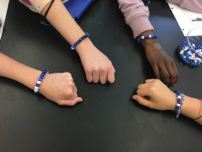
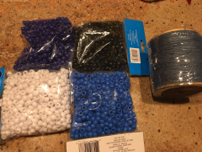
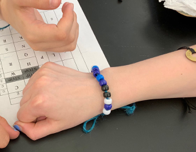
We followed this with a hands-on activity that required the students to use the genetic code in reverse, and determine the mRNA that encodes for a given five letter word. We taught this at Edgar Middle School, so we asked the students to encode EDGAR into mRNA (384 possible combinations of codons, but only two possible combinations of 1st and 2nd codon positions, so it was easy to check student sequences). The students then used four colors of pony beads to represent the a, c, g and u of their mRNA sequence and threaded their sequence onto a twine bracelet, which was knotted shut. Experienced beaders used fancier closures in some classes. The school colors of blue and white worked well.
Activities to teach dilution series to middle schoolers
A worksheet on dilution series using food dye. We use this activity as a way of training students in the use of pipet pumps and pipetmen in preparation for experiments with bacteriophage, but it is a useful way to visually show how dilutions work. We use falcon tubes, and the illustrations show falcon tubes, but the activity could be modified for any vessel: test tubes, small beakers, etc.
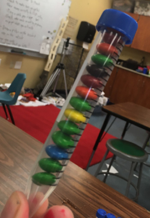
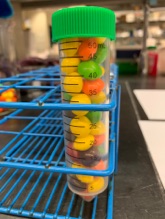
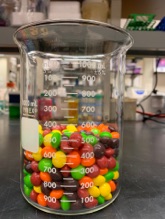
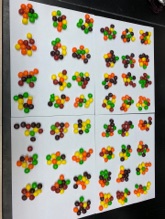
We follow this wet lab activity with a larger visual of the importance of dilutions for counting in microbiology. We put a large bag of candy (M&Ms, Skittles, etc.) into a graduated cylinder or beaker to a round number (1 liter, 700ml, etc) and get student estimates of the total number of candies (write the number down on a post-it, or the worksheet above if this activity immediately follows it). Then we sample 10% of the total volume (100ml or 70ml, following the example volumes above) in another beaker or smaller graduated cylinder, and ask the student groups to count their sample, and extrapolate the total number of candies from the sample. The exact number of candies can be counted if desired, or if 10 samples are given to students in the class the total is the sum of their individual counts. This is analogous to how microbiologists quantify their viruses and microscopic cells through dilution series. We have found some students to be excellent at guessing the correct number of candies before sampling, but that the entire class gets a good estimate of the total after they have counted their sample.